Use Case 3: Executing First AWS SageMaker Model with PySpark Notebook on Qubole
Prerequisites
Ensure that the instructions mentioned under Configuring a Qubole Spark Cluster and Configuring AWS SageMaker sections are completed.
Executing First AWS SageMaker Model with PySpark Notebook on Qubole
Navigate to the Notebooks page on the QDS UI.
On the Notebooks page, click New to create a new Notebook. The Create New Notebook pop-up window appears.
On the New Notebook pop-up window, specify all the required information. Select PySpark from the Language drop-down and the cluster (as configured under Configuring a Qubole Spark Cluster section) from the Clusters drop-down.
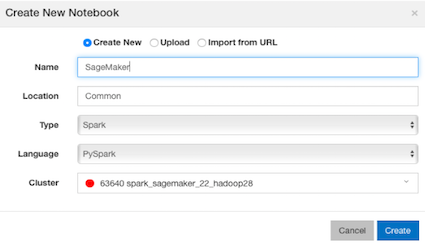
Click Create to create a new notebook. Use the codes in the notebook, mentioned from step 5 and change it per your requirement.
Import the required libraries.
from pyspark.mllib.feature import HashingTF
from pyspark.mllib.regression import LabeledPoint
from pyspark.mllib.classification import LogisticRegressionWithSGD, LogisticRegressionWithLBFGS, SVMWithSGD, NaiveBayes
from pyspark.mllib.tree import DecisionTree, GradientBoostedTrees, RandomForest
from pyspark.mllib.evaluation import MulticlassMetrics
from pyspark.mllib.util import *
Import your data from S3 to clean up and process through Qubole. This prepares the data for training. In this example, the email data is in the text format and needs to be classified as spam and non-spam emails.
spam = sc.textFile("s3-bucket for spam email data")
ham = sc.textFile("s3-bucket for non-spam email data")
Split the words in the email.
spam_words = spam.map(lambda email: email.split())
ham_words = ham.map(lambda email: email.split())

print(spam_words.take(1))
print(ham_words.take(1))
Transform the words into the integers by hashing.
tf = HashingTF(numFeatures = 200)
spam_features = tf.transform(spam_words)
ham_features = tf.transform(ham_words)

print(spam_features.take(1))
print(ham_features.take(1))
Create features from the transformed email.
spam_samples = spam_features.map(lambda features:LabeledPoint(1, features))
ham_samples = ham_features.map(lambda features:LabeledPoint(0, features))

print(spam_samples.take(1))
print(ham_samples.take(1))
Split the data into Train and test Datasets.
samples = spam_samples.union(ham_samples)
[training_data, test_data] = samples.randomSplit([0.8, 0.2])
training_data.cache()
test_data.cache()
- Convert the data into the
libsvmformat to make it understandable for SageMaker.
bucket_path="s3-bucket to store the processed data"
prefix="spam-classifier/"

training_set_directory="spam-classifier-training-data-svm"
test_set_directory="spam-classifier-test-data-svm"

training_set_path=bucket_path+prefix+"train/"
test_set_path=bucket_path+prefix+"test/"

MLUtils.saveAsLibSVMFile(training_data, training_set_directory)
MLUtils.saveAsLibSVMFile(test_data, test_set_directory)
- Upload it again to the S3 to make it accessible to SageMaker.
%sh
/usr/lib/hadoop2/bin/hadoop distcp spam-classifier-training-data-svm <s3-bucket to store the processed data>/train
/usr/lib/hadoop2/bin/hadoop distcp spam-classifier-test-data-svm <s3-bucket to store the processed data>/test
- Import the required libraries and create a client connection to AWS SageMaker with the Boto3 library.
import boto3
containers = {'us-west-2': '433757028032.dkr.ecr.us-west-2.amazonaws.com/xgboost:latest',
        'us-east-1': '811284229777.dkr.ecr.us-east-1.amazonaws.com/xgboost:latest',
        'us-east-2': '825641698319.dkr.ecr.us-east-2.amazonaws.com/xgboost:latest',
        'eu-west-1': '685385470294.dkr.ecr.eu-west-1.amazonaws.com/xgboost:latest'}
container = containers['us-east-1']
- Define the training template for SageMaker to create a model. Ensure that you define the
rolein the following code.
from time import gmtime, strftime
job_name = 'spam-classifier-logistic-1-' + strftime("%Y-%m-%d-%H-%M-%S", gmtime())
role = "<define your AWS role here>"
create_training_params = \
{
    "AlgorithmSpecification": {
       "TrainingImage": container,
       "TrainingInputMode": "File"
    },
    "RoleArn": role,
    "OutputDataConfig": {
      "S3OutputPath": bucket_path + prefix + "output"
    },
    "ResourceConfig": {
      "InstanceCount": 1,
      "InstanceType": "ml.m4.4xlarge",
      "VolumeSizeInGB": 5
    },
    "TrainingJobName": job_name,
    "HyperParameters": {
      "silent":"0",
      "objective":"binary:logistic",
      "num_round":"100"
    },
    "StoppingCondition": {
       "MaxRuntimeInSeconds": 3600
    },
    "InputDataConfig": [
       {
         "ChannelName": "train",
         "DataSource": {
           "S3DataSource": {
             "S3DataType": "S3Prefix",
             "S3Uri": training_set_path,
             "S3DataDistributionType": "FullyReplicated"
          }
         },
          "ContentType": "libsvm",
          "CompressionType": "None"
    },
     {
          "ChannelName": "validation",
          "DataSource": {
          "S3DataSource": {
            "S3DataType": "S3Prefix",
            "S3Uri": test_set_path,
            "S3DataDistributionType": "FullyReplicated"
          }
         },
         "ContentType": "libsvm",
         "CompressionType": "None"
     }
    ]
}
Train the job in SageMaker. Update the AWS Access and Secret Keys in the following code.
import time
access_key_id = "<access-key>"
secret_access_key = "<secret-key>"
client = boto3.client('sagemaker', region_name='us-east-1', aws_access_key_id=access_key_id, aws_secret_access_key=secret_access_key)
client.create_training_job(**create_training_params)

status = client.describe_training_job(TrainingJobName=job_name)['TrainingJobStatus']
print(status)
while status !='Completed' and status!='Failed':
 time.sleep(60)
 status = client.describe_training_job(TrainingJobName=job_name)['TrainingJobStatus']
 print(status)
Define the model.
model_name=job_name+"-model"

info = client.describe_training_job(TrainingJobName=job_name)
model_data = info['ModelArtifacts']['S3ModelArtifacts']

primary_container = {
  'Image': container,
  'ModelDataUrl': model_data
}

create_model_response = client.create_model(
   ModelName = model_name,
   ExecutionRoleArn = role,
   PrimaryContainer = primary_container)
Define the endpoint.
endpoint_config_name = 'spam-classifier-' + strftime("%Y-%m-%d-%H-%M-%S", gmtime())

create_endpoint_config_response = client.create_endpoint_config(
  EndpointConfigName = endpoint_config_name,
  ProductionVariants=[{
    'InstanceType':'ml.m4.xlarge',
    'InitialVariantWeight':1,
    'InitialInstanceCount':1,
    'ModelName':model_name,
    'VariantName':'AllTraffic'}])
Create the endpoint and host the model.
endpoint_name = 'spam-classifier-endpoint' + strftime("%Y-%m-%d-%H-%M-%S", gmtime())

create_endpoint_response = client.create_endpoint(
  EndpointName=endpoint_name,
  EndpointConfigName=endpoint_config_name)

resp = client.describe_endpoint(EndpointName=endpoint_name)
status = resp['EndpointStatus']

while status=='Creating':
 time.sleep(60)
 resp = client.describe_endpoint(EndpointName=endpoint_name)
 status = resp['EndpointStatus']
 print("Status: " + status)
print("Status: " + status)
Test the model to see its predictions.
runtime_client =  boto3.client('runtime.sagemaker', region_name='us-east-1', aws_access_key_id=access_key_id, aws_secret_access_key=secret_access_key)

spam_message = "23:2.0 27:1.0 30:1.0 34:1.0 42:1.0 45:2.0 61:1.0 70:1.0 71:1.0 74:1.0 87:1.0 100:1.0 104:1.0 107:1.0 108:1.0 127:1.0 130:1.0 160:1.0 169:1.0 183:1.0 189:1.0"
response = runtime_client.invoke_endpoint(EndpointName=endpoint_name,
                   ContentType='text/x-libsvm',
                   Body=spam_message)
result = response['Body'].read()
result = result.decode("utf-8")
print(result)

ham_message = "2:1.0 10:1.0 13:1.0 18:1.0 23:1.0 29:1.0 44:1.0 67:1.0 72:1.0 74:1.0 82:1.0 89:1.0 96:1.0 107:1.0 115:1.0 117:1.0 118:1.0 119:1.0 122:3.0 124:1.0 148:3.0 164:4.0 166:4.0 171:1.0"
response = runtime_client.invoke_endpoint(EndpointName=endpoint_name,
                   ContentType='text/x-libsvm',
                   Body=ham_message)
result = response['Body'].read()
result = result.decode("utf-8")
print(result)
A Machine Learning model with SageMaker is created successfully.